
For a contract manufacturer, switching quickly between clients, processes and scales is part of the service being sold. This article looks at how single-use systems support that across Southeast Asia, and where they fall short.
Picture the planning board at a mid-sized CDMO. One suite is finishing a sponsor’s campaign. The next slot belongs to a technology transfer: a process developed elsewhere, at small scale, on a resin and buffer system the site has never run. A third sponsor wants an engineering run at a batch size that matches neither. On the schedule, each transition takes a few days. The people who will carry them out know what those days contain: cleaning, verification, line clearance, re-plumbing, paperwork, and the question every quality head asks about carryover between one client’s product and the next.
A manufacturing model built around one product and one fixed process copes badly with that week. Dedicated piping, fixed vessels and long cleaning-validation cycles pay off when volumes are large and stable, and become a constraint when the next three programmes differ in scale, chemistry and timeline. That is the working reality for CDMOs, including those building capacity in Southeast Asia, and it frames the question here: how can a CDMO accommodate changing manufacturing demands without giving up process consistency, contamination control or product quality?
Southeast Asia Is Not One Market
Any account of CDMO growth in Southeast Asia has to resist the idea of a single regional story. The markets differ in infrastructure, in the biologics they make and in regulatory maturity: the regulators of Singapore, Malaysia, Indonesia and Thailand are PIC/S participating authorities, while Vietnam’s is still working towards closer alignment with international GMP benchmarks.
Singapore is the established end, and its recent announcements lean towards specialised capability: antibody-drug conjugates, cell and gene therapy, and a modular drug-product facility at a CDMO site. Specialised work tends to mean smaller, more varied campaigns. Malaysia’s visible biologics capacity has been built around specific products, insulin above all, a model with different flexibility needs from a multi-client CDMO. Thailand has a biologics manufacturer with an EU GMP-certified site that announced a cell and gene therapy centre with a UK-based partner in 2025. Indonesia pairs a very large domestic market with a technology-transfer route to local manufacture; its first locally produced monoclonal antibody product came through transfer from a European company. Vietnam’s biologics manufacturing base is earlier in its build-out.
South Korea and India are comparisons, not templates: Korean CDMOs grew on large integrated campuses, Indian manufacturers on deep biosimilar experience. The Southeast Asian markets share pressures rather than a growth rate: sponsors seeking contract partners, technology transfers that must work first time, sites handling several products and scales, and dependence on qualified suppliers whose lead times and documentation become part of the production plan.
Why Flexibility Has Become an Operational Priority
For a CDMO, flexibility is a revenue question before it is a technical one. An idle suite earns nothing, and a changeover that overruns pushes back every later slot. Utilisation depends on how quickly one programme can follow another, and campaign planning on how far the planner trusts that number.
Four kinds of flexibility get lumped together. Equipment flexibility means running different volumes or unit operations on the same hardware; process configuration means rearranging the fluid path for a different process; facility design covers layout, utilities and segregation; and production scheduling is how short and predictable the gap between campaigns is. Single-use technologies in biopharma contribute to all four, unevenly.
In a stainless-steel suite the gap between campaigns is often dominated by cleaning, verification and the paperwork showing carryover limits were met. Single-use flow paths remove that work for the surfaces they cover but add their own: line clearance, assembly installation and checking, consumable staging, and cleaning of whatever stays reusable, such as skids, pumps, sensors, resins and membranes. The bottleneck moves from the cleaning crew to the warehouse and the assembly bench.
So single-use can support flexible biomanufacturing without guaranteeing it. Shorter changeovers, better productivity and clean scale-up come from process design, implementation, operator training and validation, not from the bag itself. Changing batch sizes and technology transfers test the same thing: whether the fluid path can be reconfigured without redesigning the suite. And there is a twist for CDMOs: the most flexible sites tend to be the most standardised at component level, because sponsors can arrive with preferred consumables and every one-off format adds a qualification file and an inventory line.
Single-Use Across Upstream and Downstream Processing
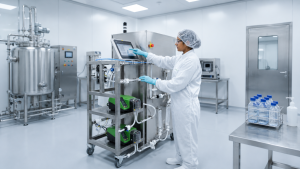
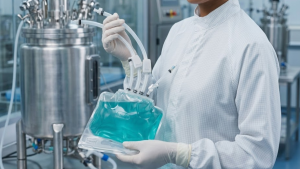
Upstream. Media and buffer preparation are often where single-use is easiest to justify: the operations are frequent, product-agnostic and heavy on cleaning schedules. Liquid storage and intermediate handling follow the same logic. XELTA 2D bags suit smaller-volume storage, transfer and process-intermediate steps, while XELTA 3D bags serve larger volumes, where the bag must keep its shape inside a support container. For compatible mixing applications, XELTA Mix Bags pair with NXTmix, a magnetically coupled, levitating-impeller design in which the impeller is driven through the bag wall and held without a bearing in the fluid path, so there is no shaft seal; the combination is a candidate for those preparation steps where the application suits. One caution applies to any mixer: flexibility in batch size is bounded by its working-volume range, so a CDMO should map typical batches to bag sizes and mixer volumes before assuming one configuration covers everything.
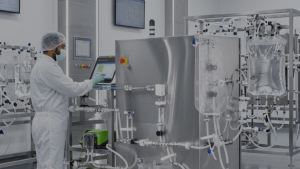
Downstream. After clarification, a process typically moves through filtration, chromatography, ultrafiltration/diafiltration and buffer exchange, with intermediate storage between steps. NXTmfilt addresses filtration applications, NXTchrom single-use chromatography and NXTtff ultrafiltration/diafiltration, with XELTA bags handling storage and transfer between them. These are different unit operations, not interchangeable options, and not every process needs every one. A single-use flow path also leaves some decisions untouched: resin dedication and lifetime, and membrane re-use, still need their own strategies.
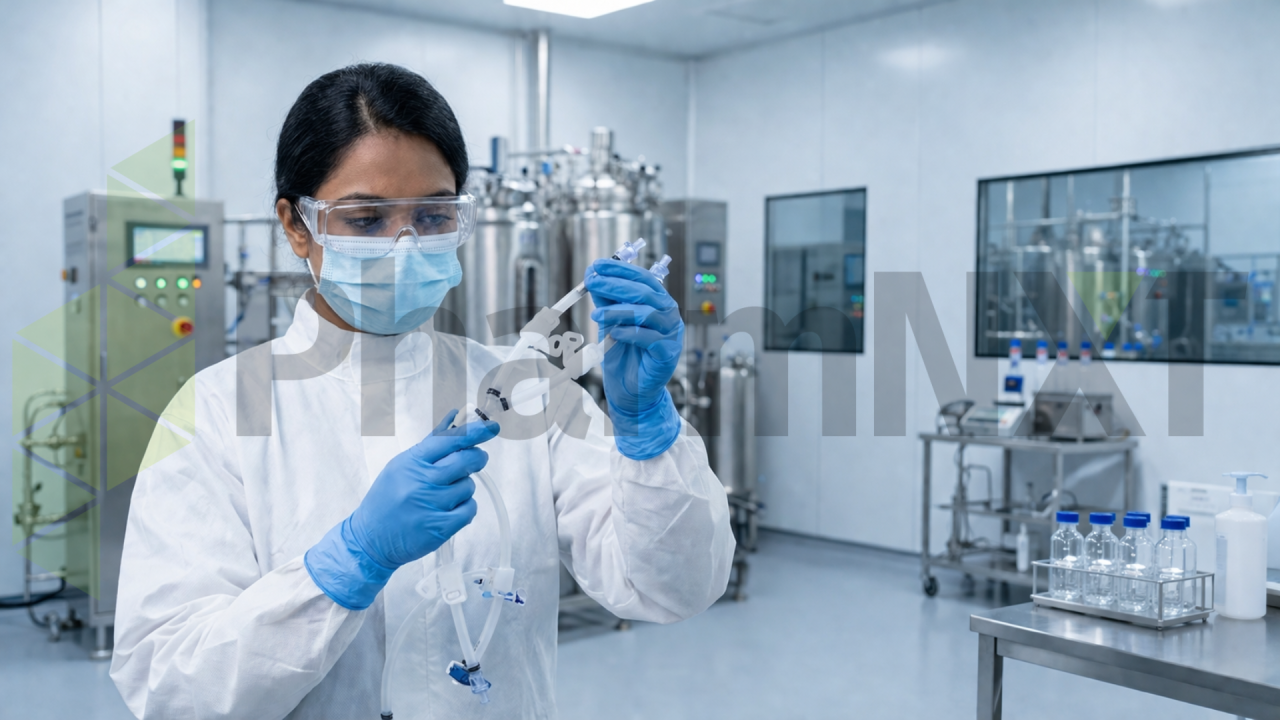
Fluid transfer and connectivity. The connections between unit operations can matter as much as the equipment on either side. XELTA KoNXT assemblies and Defined Tubing Routing (DTR) address that layer through standardised fluid pathways, organised tubing layouts and the repeatability and operator usability that follow. An adaptable facility has to be designed around the complete fluid pathway, not a list of equipment specifications.
Defined Tubing Routing: Flexibility Beyond Equipment Selection
Some of the most avoidable problems in single-use bioprocess engineering sit in the fluid path rather than the equipment. Where a line runs, where a connection sits and whether the next operator can see what goes where are design decisions, made deliberately or not. Left to chance, they produce familiar results: several similar lines in one space and no certainty which feeds the column; a connection so awkward to reach that it is made in a hurry; set-up that drifts between campaigns; troubleshooting by tracing lines by hand; and a batch record that only loosely matches what is installed.
PharmNXT’s DTR treats this as an engineering problem: define the route, connection locations, assembly configuration and access points, then repeat them. With routes defined rather than improvised, set-up is more consistent between operators and campaigns, lines can be identified visually, ergonomics are designed in, and documentation can describe what is actually installed, so second-person verification can become a comparison of installed against drawn.
For a CDMO the value lies in separating what changes from what does not. The process changes with every client; the organisation of the fluid path need not, which helps when operators move between suites, when a technology transfer must be reproduced faithfully, and when an investigation needs to establish what was connected to what. The limits are plain: DTR does not by itself guarantee compliance, eliminate error or replace validation, line-clearance checks and training. It removes one source of avoidable variation.
Single-Use and Facility Design: A Balanced View
Where single-use is suitable, fixed stainless-steel product-contact equipment gives way to mobile or modular layouts, and the demands on the building change. Those segments need fewer cleaning-in-place and steam-in-place connections but more space for consumable staging, more power for mixers and pumps, and a waste route for used assemblies. Footprint can fall, but it moves from skids to warehousing and waste handling rather than disappearing.
Contamination control shifts too. Closed single-use pathways can simplify segregation between products and clients, but closure is only as good as its weakest connection, so the contamination control strategy still has to cover connections, sampling points and consumable handling. Materials compatibility, extractables and leachables assessment and supplier documentation move to the centre of the qualification file.
None of this makes single-use the answer everywhere. Stainless steel can retain the advantage for large, stable volumes, long dedicated campaigns and very large buffer volumes, where the economics of cleaning amortise well. Many facilities end up hybrid, for example single-use bioreactors and intermediate storage alongside stainless-steel buffer preparation. The right balance depends on process scale, product portfolio, utilisation, facility strategy and economics.
Where Adoption Gets Hard
Flexibility depends on a technology and supply ecosystem that behaves as predictably as the equipment. The first constraint is access: dependable supply of qualified bags, assemblies and hardware, with lead times that fit campaign planning. A custom assembly that takes longer to arrive than the planning horizon allows is a scheduling problem disguised as a purchasing one, and storage conditions and shelf life for irradiated components, particularly in warm, humid climates, deserve explicit attention.
Behind access sits qualification. Compatibility and extractables and leachables assessments are specific to process conditions, so they cannot simply be inherited from the last campaign. Supplier qualification is a project in its own right, and validation and documentation multiply with every additional format a site holds. Operator training is the quieter constraint, because a site running many configurations needs people who can install each one correctly.
Waste belongs in the same assessment: used assemblies need a defined route for segregation, treatment and disposal, and the options differ between markets and sites. Finally, configurations must match actual process needs. An oversized bag, or a mixer run outside its working-volume range, undermines the flexibility it was bought to provide.
The Supplier Side of the Equation
PharmNXT is one example of a supplier working on this problem from the engineering side. It manufactures single-use bags and provides single-use bioprocess hardware, with a portfolio that supports multiple stages of bioprocessing, and has supplied products to more than 14 countries. It serves leading biopharmaceutical manufacturers, and its positioning centres on engineering-led solutions and manufacturing in India for global markets. For a CDMO, a portfolio spanning several stages can reduce the number of supplier interfaces to qualify, provided compatibility is verified for each process rather than assumed.
Choosing Single-Use Systems for CDMOs: Questions Worth Asking
A workable framework starts from the process, not the product list. Six questions to put to any supplier of single-use bags and hardware:
- Does it fit the process? Chemistry, pH, hold times, temperature and the working-volume range of bags and mixers, checked against real campaigns rather than generic claims, and how the configuration scales.
- Can the film and bag be defended? Film composition and compatibility with your fluids, extractables data generated to a recognised protocol, and evidence of sterility and integrity, including irradiation records and integrity testing.
- Is it traceable and controlled? Lot traceability, and change-notification terms that cover resin, additive and process changes.
- Do the connections come with it? Available assemblies and connectors, and fit with existing skids, controllers and routing practice.
- Will supply and support hold up? Lead times, buffer stock, and technical support through technology transfer and troubleshooting.
- What does it cost to own? Consumables, labour, validation effort, training, storage and waste, weighed against the manufacturing and regulatory environment you serve.
Choosing a bag from one supplier, a mixer from another and assemblies from a third can work, but it makes the CDMO the integrator, carrying the compatibility risk and documentation burden between them. That cost is absent from any quotation and tends to surface during qualification.
Flexibility Has to Be Engineered
CDMO competitiveness will depend on more than installing flexible equipment. It depends on coordinated decisions across process design, facility layout, fluid pathways, consumables, hardware, supplier relationships and quality systems, made together rather than one at a time. As CDMO growth in Southeast Asia continues at different speeds in different markets, the sites that handle change best are likely to be those that engineered for it from the start.
If CDMOs are expected to adapt to increasingly diverse manufacturing demands, shouldn’t flexibility be engineered into the entire process, not just the equipment?