
Why the real engineering challenge in modern bioprocessing isn’t any single unit operation — it’s what happens at the point where one hands off to the next
A process flow diagram divides a biopharmaceutical process into tidy boxes: cell culture, harvest, clarification, filtration, chromatography, concentration, formulation. Manufacturing teams don’t experience it that way. They experience one connected process, where a decision made at the bioreactor — a hold time, a cell density, a harvest volume — shows up three unit operations later as a filter that clogs faster than expected or a chromatography load that doesn’t match the column’s design basis.
Single-use technologies didn’t originate to fix this. They originated to solve problems inside individual unit operations — contamination risk, cleaning validation, changeover speed. But the more of the process that runs on single-use components, the more obvious a different question becomes: what happens when those components are designed as an integrated process ecosystem, rather than as individual disposable parts that happen to sit next to each other on a P&ID?
What Does “Integration” Actually Mean?
Integration doesn’t mean connecting equipment with tubing. Two single-use systems can be physically connected and still be poorly integrated — hold times that don’t match what the process actually needs, transfer volumes that don’t match vessel geometry, sampling points positioned for convenience rather than representative sampling, or documentation that treats each unit operation as its own validated island instead of one continuous fluid pathway.
That’s the real distinction: equipment integration is about compatible connectors and matching flow rates. Process integration is about whether contamination control, automation, and operator intervention are designed as one coherent system across the boundary — not whether the tubing happens to fit.
Upstream: Building the Single-Use Foundation
Upstream is where this thinking has to start, because every downstream inconsistency traces back to a decision made here. Single-use bioreactors set the fluid pathway that harvest and clarification will inherit. Media and buffer preparation both depend on mixing systems that can dissolve, disperse, and hold a solution at defined homogeneity before it’s needed — get that wrong, and the inconsistency doesn’t surface until a downstream chromatography step behaves unpredictably.
Intermediate storage is where this becomes a materials question as much as a process one: two-dimensional bags, like PharmNXT’s XELTA 2D bags, handle flexible, lower-volume storage between steps, while a larger-volume, three-dimensional format like XELTA 3D bags carries the structural demands of holding significant fluid mass without distorting under its own weight. Mixing systems like NXTmix, paired with bags engineered for constant agitation such as XELTA Mix Bags, sit at the center of both media and buffer prep — not as separate tools, but as one system that needs to behave the same way whether it’s dissolving powder at bench scale or running a commercial batch.
Mixing: The Bridge Between Multiple Unit Operations
It’s worth pausing on mixing specifically, because it touches more of the process than any other single operation. Media prep, buffer prep, intermediate hold, even parts of formulation all depend on the same underlying capability: achieving homogeneity, dissolution, and pH stability reliably enough that the next unit operation can trust what it’s receiving.
This is where a levitating, magnetically coupled impeller system like NXTmix earns its relevance to an integration conversation rather than just a mixing one. Removing the mechanical shaft and bearing from the fluid path isn’t only a contamination-risk argument — it’s also a low-shear one, since there’s no bearing friction adding localized stress at the point sensitive cells or proteins pass through most often. It also means the same mixing principle scales more predictably from a small buffer-prep vessel to a large-volume hold, since the fluid dynamics aren’t complicated by a bearing’s wear pattern changing with size. That consistency is what lets a facility treat mixing as a reliable interface between operations rather than a variable one, without claiming it resolves every mixing challenge on its own.
Harvest and Clarification: Where Integration Problems Surface First
The transition from upstream to downstream is where integration problems become visible fastest. Harvest volume, cell density, and debris load all arrive at clarification and depth filtration as a fait accompli from whatever happened in the bioreactor — there’s little room to compensate downstream for an upstream decision that wasn’t made with this handoff in mind.
This interface becomes a bottleneck almost by default when the single-use architecture connecting it is designed unit by unit rather than as one pathway: a fluid transfer step sized for convenience rather than actual harvest volume, or a hold step inserted without accounting for the time-and-temperature sensitivity of what’s being held. None of it looks like a design flaw until a batch is already moving through it.
Downstream: Toward a Connected Single-Use Workflow
Resin-based chromatography depends on flow paths, column connections, and buffer management arriving at the column in the right sequence, volume, and condition — a single-use platform like NXTchrom is only as useful as the fluid pathway feeding it, which is exactly why chromatography hardware increasingly needs evaluating as part of a broader single-use workflow rather than as a standalone skid.
Concentration and diafiltration via tangential flow filtration bring recirculation loops, buffer exchange, and pressure management into the picture. A platform like NXTtff has to manage tubing and pressure considerations that directly affect membrane performance and product quality, not just deliver a target concentration factor.
Sterile filtration closes the loop before formulation and fill, and filter assemblies, integrity considerations, and closed fluid pathways matter here for the same reason they matter upstream: a platform like NXTmfilt is one piece of a disposable process architecture, and its value depends on how well it connects to what comes before and after it, not on filtration performance in isolation.
The Importance of Tubing and Fluid Pathway Design
This is arguably where integrated single-use processes succeed or fail in practice, and it gets far less attention than the equipment itself. Tubing length affects hold-up volume and pressure drop. Bend radius affects flow and, over time, fatigue at the bend point. Dead legs — sections of tubing where fluid can stagnate — create a contamination and mixing risk that no amount of sophisticated equipment upstream or downstream can compensate for.
On paper, two unit operations may appear perfectly compatible. On the shop floor, however, a few extra meters of tubing, an awkward connection point, or an inaccessible clamp can turn a simple transfer into an operational headache — one that shows up as an extended changeover or a missed sample, not as a line item on anyone’s process design document. Operator access, connection-point placement, and routing consistency aren’t cosmetic details; they decide whether a well-designed process actually runs the way it was designed to.
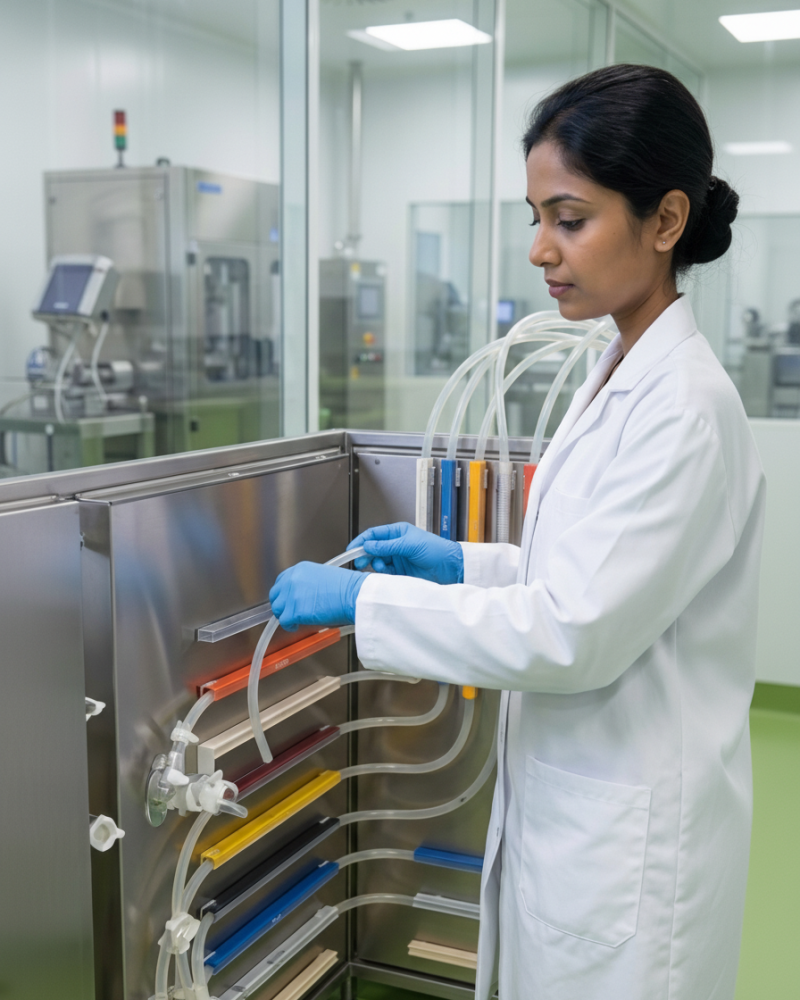
Defined Tubing Routing: Solving the Problem Nobody Draws on the P&ID
This is the specific problem Defined Tubing Routing (DTR) is built to address. The underlying engineering issue is easy to state and surprisingly hard to fix: even with well-chosen equipment, tubing routing left to interpretation — a different path each time an operator installs an assembly, ambiguous labeling, inconsistent bend geometry — introduces variability at exactly the point a process needs repeatability most.
A standardized, engineered tubing pathway addresses this directly. Installation becomes consistent regardless of which operator sets it up, narrowing the operator-error window that ambiguous routing creates. Visual identification of the correct path speeds up setup and troubleshooting, because a technician isn’t reconstructing routing logic from memory or a photo in a batch record. Documentation and validation both get easier to defend when the physical routing matches what’s written down, rather than approximating it. None of this replaces good equipment design — it’s what makes good equipment design reproducible once it leaves the qualification bench and reaches a production floor with multiple shifts and multiple operators. That’s precisely why an approach like DTR matters more, not less, as more single-use unit operations need to work together rather than in isolation.
Connections and Assemblies
Aseptic connectors, tubing welds, manifolds, and sampling points are where fluid pathway design becomes physical. Pre-configured assemblies — the kind XELTA KoNXT assemblies are built around — reduce the number of independent decisions made at installation by standardizing how components connect in the first place, rather than leaving connector selection and weld placement to be re-decided every time an assembly is built.
Single-Use Hardware as an Integrated Ecosystem
Put the upstream and downstream pieces back together and a pattern emerges: mixing bags and mixers, chromatography and TFF hardware, filtration assemblies, storage bags, and the tubing connecting all of it are rarely evaluated as one system, even though they function as one. A facility drawing NXTmix, NXTchrom, NXTtff, NXTmfilt, and the bags and assemblies around them from a single, coherently engineered platform isn’t buying a product catalogue — it’s buying the assurance that a connection validated once at one interface behaves the same way at the next. Integration, in the end, is strongest when consumables, hardware, fluid pathways, and process requirements are designed together, rather than sourced separately and reconciled afterward.
What QA and Validation Teams Need to Consider
Integrated systems don’t eliminate validation burden — they redistribute it. Supplier qualification, material traceability, extractables and leachables data, and integrity testing still need to be assembled and defended, but an integrated platform can simplify some of that work by keeping film chemistry, weld methods, and sterilization approach consistent across more of the process, rather than qualifying a different combination at every interface. It introduces its own consideration too: change control now has to track how a change in one component’s specification could ripple into an adjacent one, and component compatibility has to be verified as a system property, not just checked component by component.
Procurement: Moving Beyond Component Price
Procurement conversations built around per-component price miss where the real cost sits. A cheaper bag from one supplier and a cheaper mixer from another can still add up to a more expensive process if the two were never engineered to work together — mismatched connectors, incompatible documentation formats, a change notification that reaches one supplier’s customers and not the other’s. Total cost of ownership, supplier reliability, lead time, and technical support all matter more than unit price once a facility is running multiple interdependent single-use operations rather than one isolated component.
Local manufacturing capability is worth weighing here too, particularly for facilities in this region: a supplier close enough to shorten lead time and provide hands-on support during a technology transfer is solving a different problem than one simply offering the lowest landed cost.
Asia’s Opportunity
This is exactly the calculation facing biologics and CDMO manufacturers across South Korea, Singapore, Malaysia, Indonesia, Thailand, Vietnam, and India, where capacity is expanding fast enough that flexibility has become as important as throughput. Multi-product facilities need to change over between programs without requalifying an entire fluid pathway from scratch. Technology transfers between sites need a process that behaves the same way on a different mixer, in a different building, ideally supplied by the same coherent platform. And regional manufacturers competing for global biopharma business need to demonstrate the same engineering rigor — and increasingly the same integrated thinking — that customers expect anywhere else in the world.
PharmNXT’s own position in this picture is a fairly direct one: engineering-led development of both consumables and hardware, manufactured in India and now supplied into 14-plus countries to biopharmaceutical manufacturers working through exactly these kinds of integration questions, with the kind of process-level thinking this article has been describing built in from the start rather than assembled after the fact.
Where This Leaves the Industry
The next generation of biomanufacturing won’t be defined simply by how much stainless steel gets replaced with disposable components — that shift is largely underway already. It will be defined by whether those components form connected, standardized, flexible, and intelligently engineered process ecosystems, or a collection of individually excellent parts a facility has to reconcile on its own.
If every unit operation is becoming more flexible, shouldn’t the connections between them become just as intelligently engineered?