
How a revised EU GMP guideline is reshaping engineering decisions, supplier relationships, and facility design across Asia’s fastest-growing biologics markets
Ask a validation engineer in Seoul, Singapore, or Pune what changed after August 2023, and you won’t hear about a new form or an extra signature line. You’ll hear about a different way of arguing for a decision — from “we followed the checklist” to “we can show you why this reduces risk.” That shift is the real legacy of the revised EU GMP Annex 1, and nowhere is it showing up faster than in how Asia’s biologics manufacturers are thinking about single-use technology.
Annex 1 is a European guideline. Its influence isn’t. Across South Korea, Singapore, Malaysia, Thailand, Indonesia, Vietnam, and India, facilities that will never host an EU inspector are still redesigning cleanrooms, requalifying suppliers, and rewriting specifications around its logic. That’s worth unpacking as an engineering story, not just a compliance one.
Why Annex 1 Matters More Than Ever
Sterile manufacturing has never been forgiving of shortcuts. What changed with the 2022 revision — the first substantial rewrite of Annex 1 in over a decade — was the move from a checklist of individually satisfied requirements to a single, documented Contamination Control Strategy (CCS) that ties facility design, personnel behavior, environmental monitoring, and process technology into one accountable system.
That sounds procedural. It isn’t. A facility can no longer justify a design choice by pointing to a spec sheet; it has to show, on paper, how that choice fits the broader risk picture. For manufacturing hubs across Asia that have expanded rapidly over exactly this period, this isn’t a retrofit problem — it’s the baseline every new facility gets designed against from day one.
Why Single-Use Technology Is a Natural Fit
Closed processing answers the CCS question almost by definition: the fewer times a process opens to the room, the fewer chances contamination gets in. Single-use systems — pre-sterilized, used once, discarded — remove an entire category of risk that reusable stainless steel systems have to keep re-proving they’ve controlled: incomplete cleaning cycles, residual agents, cross-contamination between campaigns.
Faster changeovers compound the effect. Every hour a system spends in a vulnerable transition state between batches is an hour CCS is trying to design out, and single-use assemblies collapse that window considerably. It’s a large part of why single-use adoption in the region hasn’t needed much selling on technical merit alone — Annex 1 simply gave engineering teams a formal, documented reason to do what many already wanted to do.
The Engineering Reality Behind the Regulation
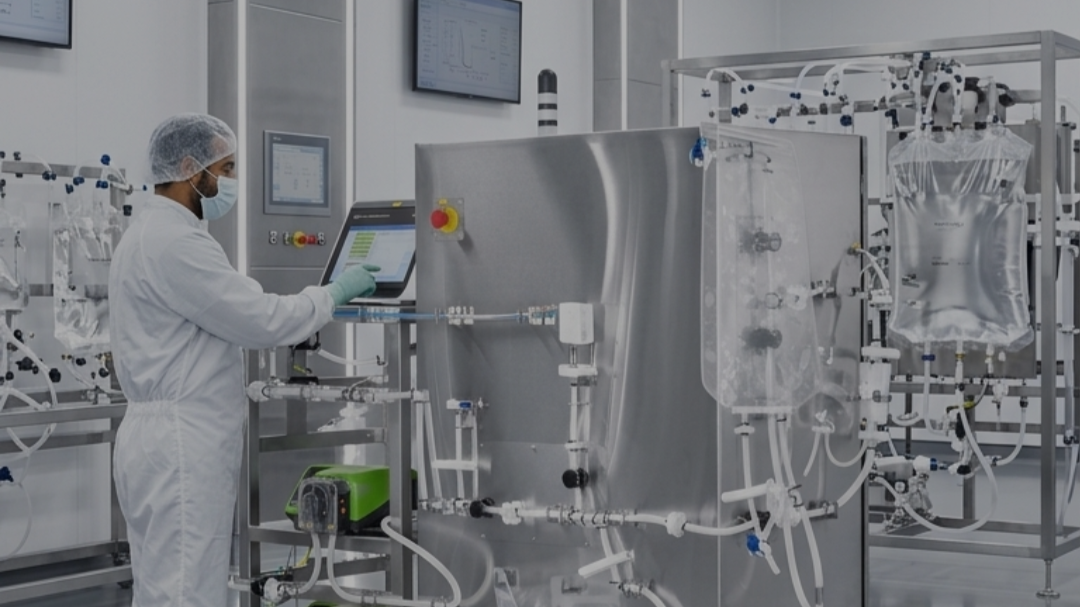
The practical effects show up first in facility layout. Less square footage goes to CIP skids and WFI loops for equipment cleaning; more goes to consumable staging, storage for single-use assemblies, and waste logistics that reusable systems never had to plan for.
Closed fluid pathways and sterile connections move from a components decision to an architecture decision — how much of a process can genuinely stay closed from raw material to fill line shapes how the rest of the facility gets built around it. Disposable assemblies need real foresight in their specification: unique identifiers, documentation that matches batch records exactly, and traceability designed in at the point of manufacture rather than added later.
That last point changes what supplier qualification means. Once single-use components sit inside the sterile boundary, the supplier is effectively an extension of the facility’s own quality system — which is why supplier qualification files across the region have gotten noticeably thicker over the past two years.
Where Validation Gets Harder, Not Easier
It’s worth being honest here: single-use technology doesn’t reduce validation burden so much as relocate it. Integrity testing — pressure decay, dye ingress, whichever method fits the assembly — has to be demonstrated for every bag, filter, and assembly, and increasingly needs to sit inside batch release rather than stand alone as a one-off qualification exercise.
Extractables and leachables data has become non-negotiable, and a generic supplier data package is a starting point, not a substitute for a facility-specific risk assessment against actual contact time, temperature, and product chemistry. Gamma sterilization validation — dose mapping, load configuration, sterility assurance — pushes a meaningful share of validation work upstream into the supply chain, but accountability stays firmly with the facility.
Change management follows the same logic. A resin change, a film reformulation, a shifted gamma dose — these need to reach the facility before they reach the process, which means change notification has to be a tracked, contractual commitment rather than a courtesy email. And every assembly used in a batch needs to trace back to its lot, which is quietly pushing serialization and barcode-linked batch records much further down the supply chain than they used to go.
Procurement’s Expanding Role in Quality
All of this has pulled procurement into territory that used to belong entirely to quality. Sourcing decisions increasingly turn on a supplier’s documented quality systems, the completeness of its technical documentation — E&L data, validation guides, certificates of irradiation — and whether change notification is treated as a formal commitment or an afterthought.
Supply continuity matters differently than it did with stainless steel: a stockout on a single-use assembly can halt a batch outright, so dual-sourcing and lead-time reliability now sit alongside price in sourcing decisions. Increasingly, the deciding factor is whether a supplier can hand over a validation support package unprompted. One that can’t gets disqualified regardless of unit price.
A Region in Motion: The View From Each Market
South Korea’s biologics base — anchored by the Songdo cluster and a CDMO sector scaling capacity year over year — sits under a regulator, MFDS, that’s been a PIC/S member for over a decade. Global suppliers have been opening local innovation hubs there for a reason: the demand and the regulatory sophistication arrived together.
Singapore’s HSA has held PIC/S membership since the scheme’s earliest years, and Tuas Biomedical Park’s dense cluster of global manufacturers means Annex 1-style thinking was never really foreign here — it formalized practices the market had largely converged on already.
Malaysia, Thailand, and Indonesia are PIC/S members in their own right, and Vietnam is moving through ASEAN’s mutual recognition pathway toward the same standards. What’s interesting about this cluster isn’t how far behind it started — it’s how little legacy infrastructure it has to unwind. Newer facilities here can build single-use, closed-processing thinking in from the outset, and in some cases are reaching CCS maturity faster than markets still modernizing decades of installed stainless steel.
India’s story is a little different, and worth stating plainly: formal PIC/S accession is still pending. That hasn’t been the deciding factor for the country’s export-oriented manufacturers, whose CDMO and biologics sector has been scaling fast on the back of single-use adoption and increasingly specialized capability. Their customers — global biologics manufacturers and CDMOs across every market above — expect international-standard documentation regardless of what the domestic regulator has formalized, so that’s the standard they build to.
This is where a company like PharmNXT fits the picture — not as an exception, but as an illustration. Based out of a manufacturing facility in Chakan, Pune, its engineering teams have spent recent years developing single-use platforms like the DTR™ (Defined Tubing Routing) system, built specifically around closed-pathway, reduced-intervention principles rather than retrofitted onto older designs. With commercial reach into 14-plus countries — several of the markets discussed above — it’s a useful example of where regional capability is heading: manufacturing rooted in India, engineered to a standard that doesn’t need translating wherever it ships.
What Comes Next
Expect greenfield facilities across the region to default to single-use and hybrid platforms from the outset, rather than justify them as an alternative to stainless. Expect supplier selection to keep tilting toward those who can produce Annex 1-aligned documentation proactively — soon a baseline qualifying criterion, not a differentiator. Expect more regional guidance to build on Annex 1’s logic rather than simply reference the EU text wholesale, the way regulators elsewhere have already begun doing.
Digital traceability is the next real gap. Batch records, component serialization, and supplier data still move through too many disconnected PDFs and certificates for the kind of real-time oversight Annex 1 was written to enable, and closing that gap will matter more than any single facility upgrade. On the single-use side itself, the next round of innovation is likely to be about standardizing connector and interface design across suppliers, so facilities aren’t quietly locked into one vendor’s ecosystem by the shape of a fitting.
Annex 1 was never really a document to comply with once and file away. It has become the shared vocabulary for what “in control” means across sterile manufacturing — and Asia’s manufacturers, rather than importing that vocabulary secondhand, are writing their own regional chapter of it, often faster than outsiders assume.
So here’s the honest question worth sitting with: where’s the biggest gap between your facility’s contamination control strategy today and what the next inspection — wherever it comes from — will expect? I’d like to hear how others across the region are closing it.