

Why the engineering behind a single-use bag matters as much as the process it’s built to support — and what that means for facilities scaling across Asia’s biomanufacturing hubs
A single-use bag looks like the simplest component in a bioprocess suite — a bag, a port, maybe a tubing set. It’s also one of the few components that sits in direct, sustained contact with product for hours or days at a time, under mechanical stress, at defined temperatures, often carrying material that represents months of upstream work. Treating it as a commodity is where a surprising number of process deviations start.
That distinction matters more as biomanufacturing capacity expands across South Korea, Singapore, Malaysia, Indonesia, Thailand, Vietnam, and India. Facilities producing biologics, vaccines, biosimilars, and cell and gene therapy products are scaling fast, and the bags carrying their buffers, media, and intermediates are being asked to perform consistently across sites, suppliers, and process generations. That consistency starts with material science, not a procurement price sheet.
Why Material Selection Matters
Every property a bag needs traces back to polymer structure and chain architecture, and those properties tend to trade off rather than stack neatly. A polymer chosen for chemical inertness and flexibility isn’t automatically the one with the best puncture resistance. Push mechanical strength up and flexibility can suffer; increase barrier performance and the film can get stiffer and more prone to failure under repeated flexing.
Stress cracking is the failure mode this trade-off makes visible. A film with excellent tensile strength on a data sheet can still crack under sustained strain if it lacks environmental stress-crack resistance — a distinct polymer property, not a byproduct of general strength. That’s why a film engineered for static storage, sitting still at controlled temperature, isn’t automatically right for a bag that will flex constantly under agitation, or one that needs to tolerate freeze-thaw cycling without embrittling. The application defines the requirement; the film has to be selected against that requirement, not against a generic “single-use compatible” label.
Film Construction: What Each Layer Is Actually Doing
Most bioprocessing films aren’t a single material — they’re a laminate of several layers, each doing a job the others can’t. The outer layer’s job is mechanical: abrasion, puncture, and tear resistance, protecting everything underneath from handling damage. Structural and barrier layers sit in the middle, often polyethylene-based, providing tensile strength and controlling gas transmission — how much oxygen or carbon dioxide moves through the film matters directly to a live cell culture, and that control usually needs a dedicated layer rather than relying on the product-contact layer to do double duty.
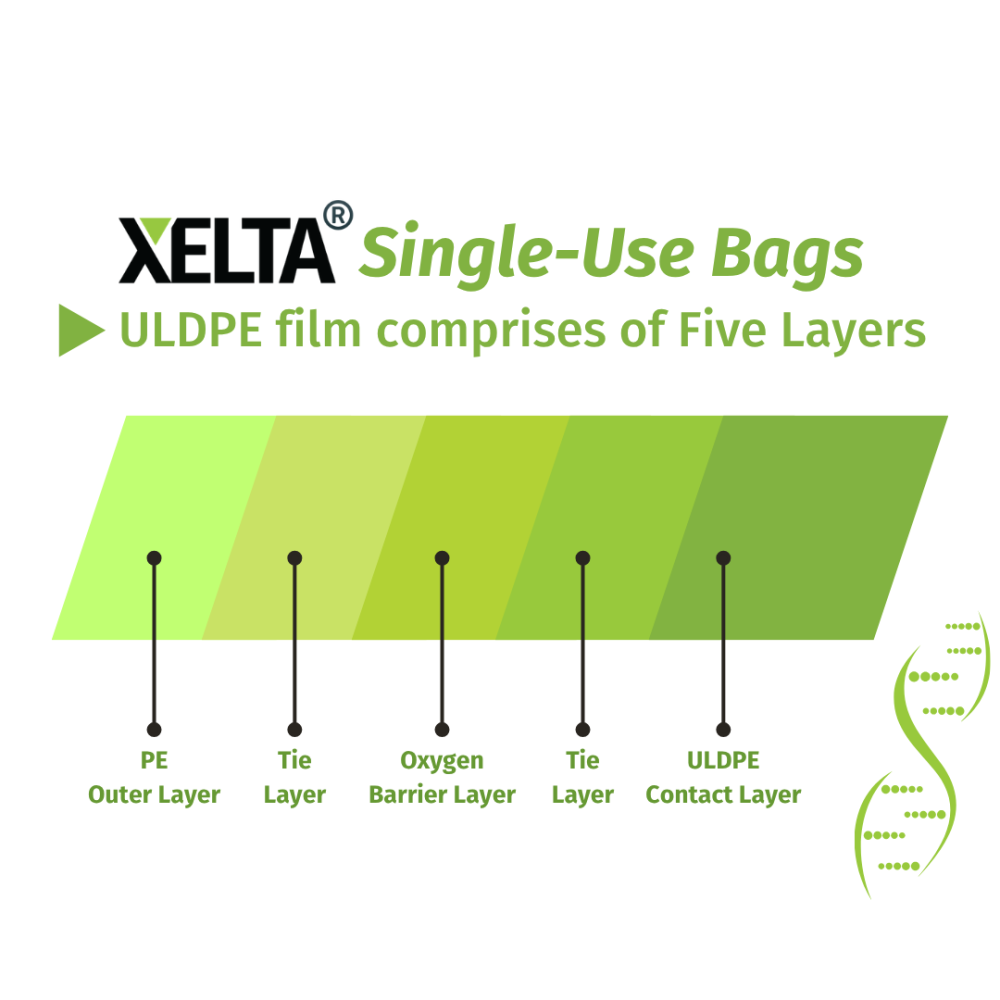
The product-contact layer carries the most engineering weight of any layer in the stack, because it’s the only one actually touching the product. It has to be chemically compatible with the fluid it holds, generate a minimal extractables profile, and support — or at least not interfere with — cell growth where cells are present. This is where a bag built for storage, such as XELTA 2D bags, and one built for constant agitation, such as XELTA Mix Bags, start to diverge even when both use a related polyethylene-based contact layer: a mixing application adds cyclic mechanical stress a static storage bag never experiences, which changes what “compatible” needs to mean for that specific film.
XELTA Mix Bags illustrate the point well. The film runs a five-layer construction at roughly 325 microns — thick enough to withstand constant flexing against an impeller without sacrificing the flexibility mixing depends on, a trade-off a thinner, storage-oriented film wouldn’t need to make. The product-contact layer is a ULDPE (ultra-low-density polyethylene), chosen for flexibility and resistance to stress cracking under repeated mechanical flexing, while a PE outer layer takes on abrasion and handling resistance so the contact layer doesn’t have to compromise its own chemistry to survive rough handling.
Material Compatibility Is a Process Question, Not a Material Claim
A supplier’s compatibility chart is a starting point, not an answer. Real compatibility depends on the actual fluid — its pH, ionic strength, protein concentration, any solvent or cleaning-adjacent chemical present — combined with contact time, temperature, and mechanical condition. A film that’s stable holding a neutral buffer at room temperature for an hour may behave differently holding a low-pH viral inactivation buffer for an extended hold, or a high-salt elution buffer under agitation.
This is why a film’s stated pH tolerance matters practically, not just as a spec-sheet number. XELTA Mix Bags are rated across roughly pH 2.5 to 11 — wide enough to span most of what a facility encounters, from low-pH viral inactivation through higher-pH equilibration and cleaning-adjacent buffers — with a degree of solvent resistance for fluids outside pure aqueous chemistry. The practical benefit isn’t the number itself: a facility can standardize on one mixing bag platform across multiple unit operations instead of qualifying a different film for every pH range it touches, a real reduction in validation and inventory complexity.
Extractables and Leachables: Where Chemistry Meets Risk
Extractables are compounds that can be pulled out of a plastic under deliberately aggressive test conditions, designed to reveal the full universe of what a material could release. Leachables are the subset that actually migrates into product under real, normal-use process conditions. The distinction matters because an extractables study defines the risk universe, while a leachables assessment tells you what’s actually relevant to your process, weighed against a toxicological safety threshold rather than a bare detection limit — and both regulators and internal QA teams expect that connection made explicitly, not assumed.
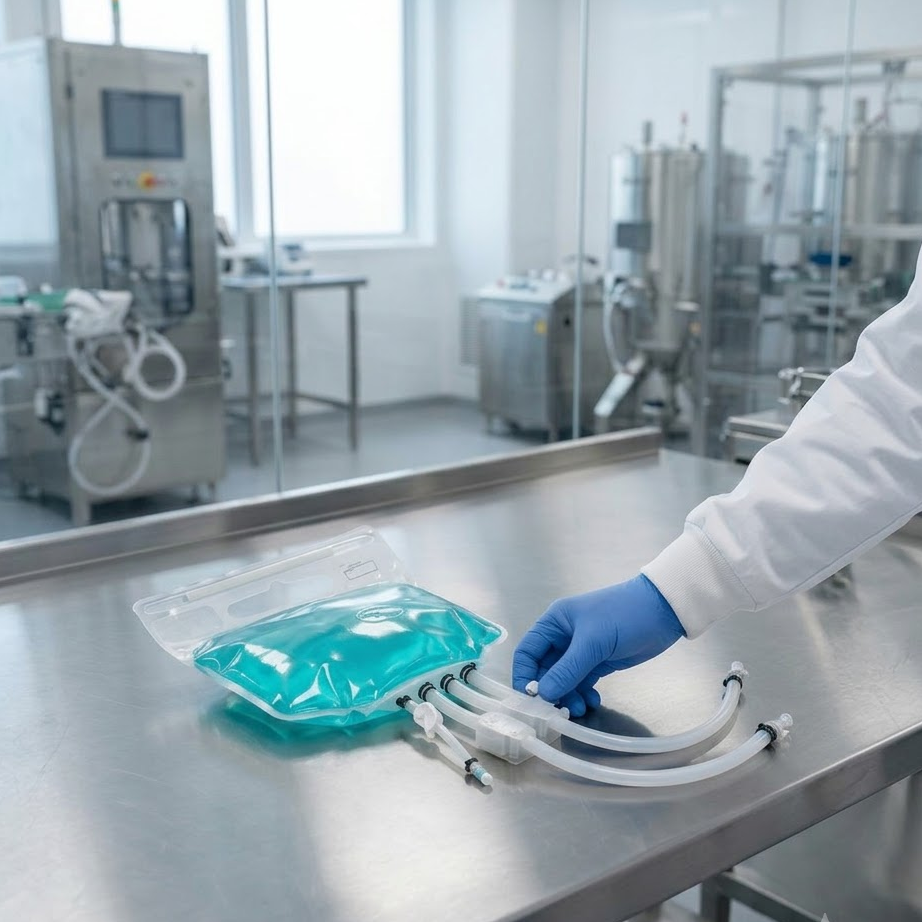
This isn’t theoretical. The field has documented real cases of a leachable — often a degradation product of an antioxidant additive in an older polyethylene formulation — suppressing cell growth in a bioreactor, traced back weeks later to a single-use component upstream. That history is a large part of why the industry has moved toward standardized, more rigorous extractables protocols, and it’s also why USP General Chapter <665>, which became a mandatory compendial standard for plastic components in biopharmaceutical manufacturing earlier this year, is a bigger deal than its chapter number suggests. It formalizes exactly the kind of process-specific risk evaluation E&L assessment always should have been. A generic extractables data package from a film supplier is a necessary starting point; a defensible risk assessment still has to layer in the actual contact time, temperature, and product chemistry of the process the bag will run in.
Sterility and Integrity: The Whole Boundary, Not Just the Bag
Gamma irradiation is how most single-use bags achieve sterility assurance, and validating that dose — through dose mapping and load configuration — is a supplier-side responsibility a facility still has to verify, not simply trust. But sterility assurance for the bag itself only covers part of the boundary. A bag is only as sterile as its weakest connection point, and connection points are where seals, ports, and tubing welds carry as much risk as the film.
This is where assemblies matter as much as the bag. XELTA KoNXT assemblies — the tubing, connectors, and ports that carry fluid into and out of a bag — are engineered as a defined, tested system rather than components assumed to work together because they happen to be compatible sizes. A weld that hasn’t been validated for tensile and burst strength, or a port that hasn’t been leak-tested under the process’s actual pressure, is a failure point regardless of how good the bag film is. Leak testing and visual inspection both have a role here: pressure or vacuum decay testing finds a breach too small to see, while visual inspection catches gross defects, particulate, or seal irregularities that a pressure test alone might miss.
Mechanical and Operational Risks: Where Design Meets the Real World
Plenty of bag failures have nothing to do with the film itself and everything to do with how the bag was installed, filled, or moved. Overfilling stresses seams beyond their design tolerance. Excessive agitation on a bag not engineered for that mixing profile accelerates fatigue at flex points. Improper support during operation — a bag not seated correctly in its holder or bin — concentrates stress on a single area instead of distributing it, which is often where a “random” puncture actually originates.
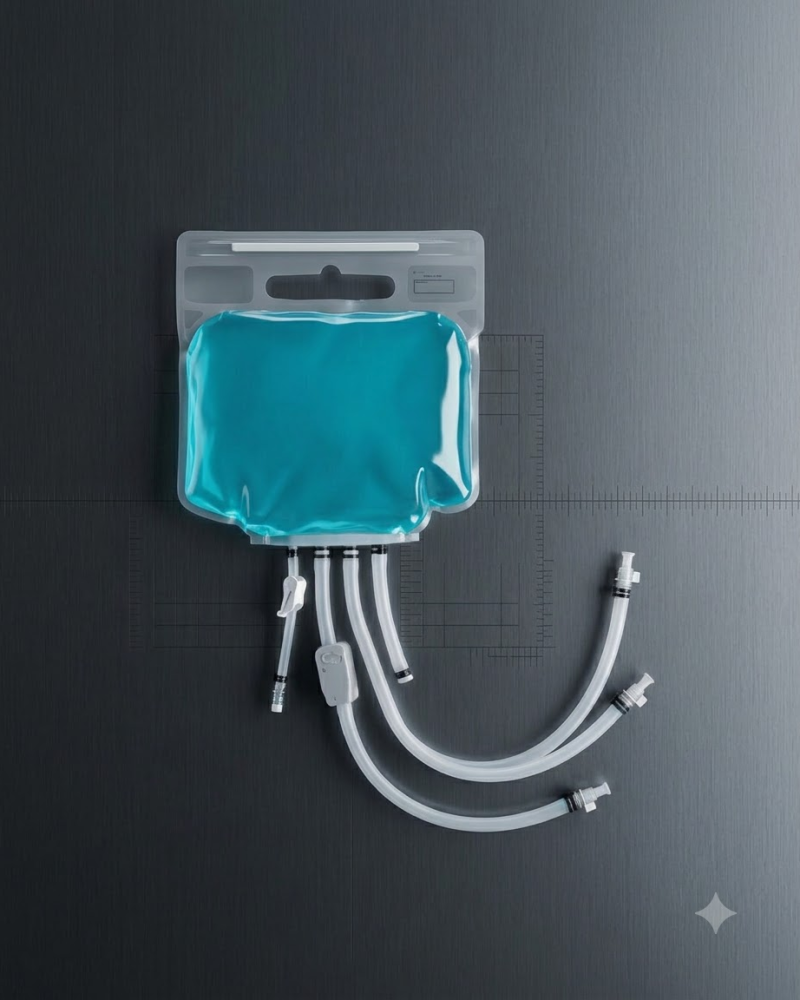
This is why larger-volume applications need different structural thinking than smaller ones. A two-dimensional bag lying flat in storage carries its weight differently than a large-volume, three-dimensional bag that needs to hold its shape and support significant fluid mass during active processing — why something like XELTA 3D bags is engineered with geometry and support-bin integration considered together, not as an afterthought once volume scales up. Transportation and storage conditions add another layer entirely: temperature excursions, physical shock, and repeated flexing in transit can all pre-stress a film before it ever reaches the process floor, which is why handling procedures deserve the same engineering attention as the bag design itself.
What Technical and QA Teams Should Actually Ask Suppliers
Qualifying a single-use bag supplier is a broader exercise than confirming a film meets spec. It’s worth asking for exact film composition and layer construction, not just a material family name; complete extractables and leachables documentation tied to relevant process conditions, not a generic summary; gamma irradiation dose records for the specific lot in question; and integrity testing data appropriate to the bag’s actual application, not a boilerplate certificate.
Traceability matters just as much: can a specific bag be traced back to its film lot and manufacturing date, and will the supplier notify you before changing a resin, an additive, or a manufacturing process that could shift an extractables profile you’ve already qualified against? Raw-material consistency, manufacturing environment controls, packaging integrity, and validated transportation conditions round out the picture — and so does the depth of technical support available when something in your process doesn’t match the data sheet. A supplier who can answer these questions with real data, unprompted, is telling you something about how they engineer, not just how they manufacture.
That question carries extra weight for facilities across South Korea, Singapore, Malaysia, Indonesia, Thailand, Vietnam, and India, where biologics, biosimilar, vaccine, and cell and gene therapy capacity has expanded faster than the regional supply base for validated consumables has traditionally kept pace with. Dedicated single-use design infrastructure — including a facility that opened in India’s Genome Valley in late 2025 — signals the region building that base locally, and material consistency and supplier documentation only matter more as that manufacturing moves closer to home.
PharmNXT, engineering and manufacturing its XELTA and NXTmix platforms out of India and now supplying into 14-plus countries, sits inside that same shift — a reminder that engineering depth doesn’t have to be imported to be credible, provided it’s held to the same evidentiary standard biologics manufacturers expect anywhere else.
The Bottom Line
A single-use bag is not a disposable container that happens to touch your product — it’s a process-contact component whose material, construction, and manufacturing quality shape whether that process behaves the same way batch after batch. Treating it that way changes what “good enough” means: from a bag that doesn’t leak to a bag that can show, on paper, why it won’t.
As biomanufacturing capacity across the region keeps scaling, the facilities getting ahead won’t be the ones sourcing bags on price or availability alone. They’ll be the ones asking their suppliers to show the engineering — and choosing the ones who can.