
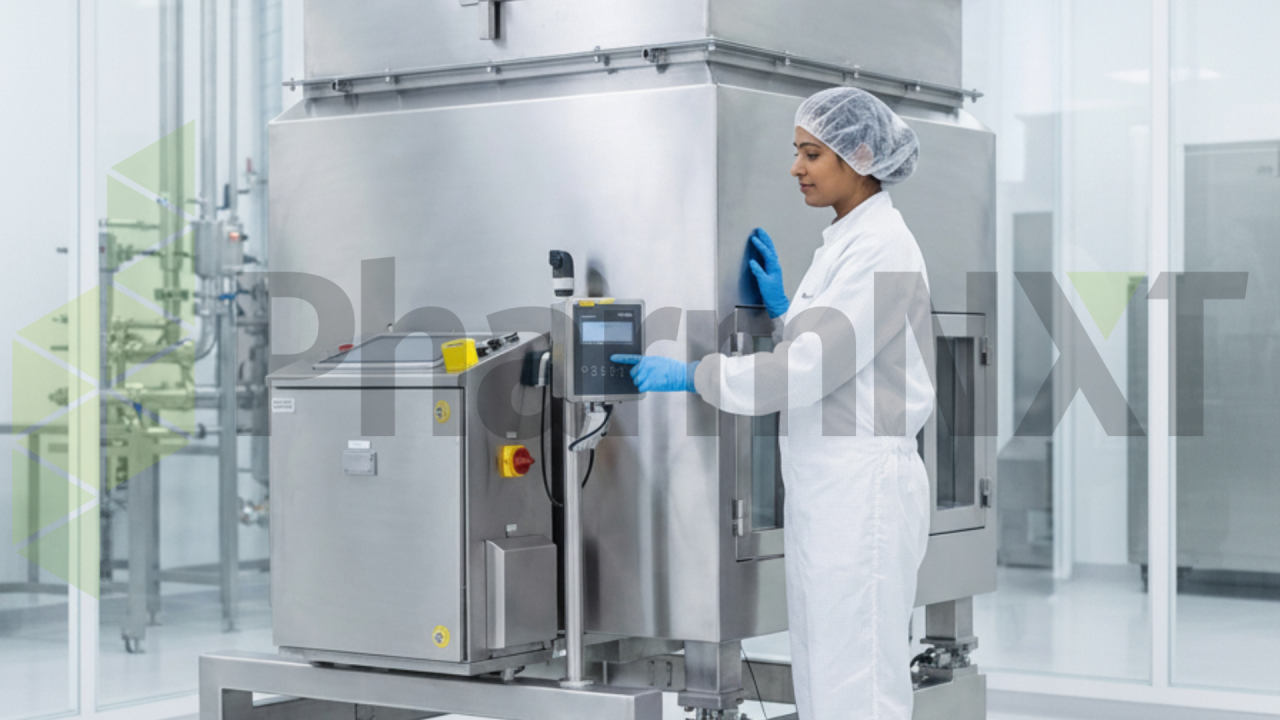
In biologics manufacturing, the most expensive equipment is not the bioreactor. It is the one sitting idle.
The Downtime Problem Nobody Talks About Loudly Enough
Ask any manufacturing head at a biologics facility what keeps them up at night, and “downtime” will appear somewhere in the first three answers. Not because it is a new problem — but because the cost of it has never been higher.
Biologic drug substances are expensive to produce, operate on tight batch schedules, and serve patient populations where supply continuity is not optional. A single unplanned shutdown — for cleaning validation failure, equipment maintenance, cross-contamination investigation, or changeover delays — can cascade into missed delivery commitments, regulatory deviations, and revenue losses that dwarf the cost of whatever caused the stoppage.
Across South Korea’s rapidly expanding CDMO sector and Southeast Asia’s emerging biologics manufacturing base, this pressure is particularly acute. Facilities are being asked to run multiple products, accommodate shorter campaigns, respond to shifting client demand, and maintain GMP compliance — all simultaneously, often with lean operational teams. The margin for unplanned downtime is essentially zero.
Single-use systems were not designed specifically to solve the downtime problem. But the more facilities deploy them at scale, the clearer it becomes that disposable technologies address several of the most persistent sources of manufacturing delay in ways that traditional stainless-steel setups simply cannot match.
What Actually Causes Downtime in Traditional Bioprocess Facilities
Before discussing what single-use systems change, it is worth being specific about what they are changing from. Downtime in traditional stainless-steel biomanufacturing is not usually caused by dramatic equipment failures. It is caused by the accumulation of operationally necessary but time-consuming activities that eat into productive manufacturing hours.
CIP and SIP cycles are the most significant. Clean-in-place and steam-in-place validation for bioreactors, vessels, and piping systems is not quick. A thorough CIP cycle for a large stainless bioreactor — pre-rinse, caustic wash, acid wash, final rinse, integrity verification — can take six to twelve hours depending on vessel geometry and product contact surface area. SIP adds additional time. When you are running sequential campaigns in a multi-product facility, this is not background activity. It is scheduled downtime, built into the production calendar.
Cleaning validation between products adds another layer. Switching from one biologic to another in a shared stainless-steel manufacturing suite requires documented evidence that the previous product has been removed to below defined limits. This is not a fast process. Swab sampling, analytical testing, results review, and QA release can extend product changeover to days — occasionally longer if investigations are triggered.
Equipment maintenance and qualification take equipment offline periodically for calibration, preventive maintenance, or requalification following modifications. A stainless bioreactor agitator, temperature probe, or sparger that requires maintenance pulls the vessel out of production rotation. In a facility with limited vessel capacity, that is a production constraint.
Contamination investigations are the most disruptive. A contamination event in a stainless-steel suite triggers a shutdown, a root cause investigation, re-cleaning, re-qualification, and regulatory notification — a sequence that can take weeks.
None of these are failures of engineering or operations. They are the inherent operational overhead of traditional fixed manufacturing systems.
Where Single-Use Systems Change the Equation
The operational logic of single-use systems is straightforward: if you eliminate the equipment between campaigns, you eliminate most of the activities associated with cleaning, validating, and maintaining it.
CIP and SIP elimination is the most immediately quantifiable benefit. A single-use bioreactor does not need cleaning between campaigns. The bioprocess bag is discarded; a new sterile assembly is installed. What was a six to twelve hour CIP/SIP cycle becomes an assembly and installation process measured in hours, not the cleaning process itself. For facilities running back-to-back campaigns with tight turnaround requirements — common in clinical CDMO operations — this time recovery is operationally significant.

Product changeover acceleration is the second major gain. In a stainless-steel suite, switching products means cleaning validation, which means time. In a single-use suite, switching products means replacing disposable assemblies with new, pre-sterilised components configured for the next product. The fluid pathway is inherently cleared. The contamination risk from previous product residues is eliminated by the physical replacement of contact surfaces — not demonstrated by analytical testing of surfaces that remain in place.
For CDMOs in South Korea managing four to six client products simultaneously across shared manufacturing suites, this difference is not marginal. It is the difference between scheduling feasibility and scheduling impossibility.
Reduced contamination risk has a direct operational benefit that is sometimes overlooked in downtime discussions. Contamination events in stainless-steel facilities are relatively rare but extremely disruptive when they occur. Single-use systems, by providing pre-sterilised fluid contact surfaces for each campaign, reduce the contamination risk window significantly. Fewer contamination events means fewer investigations, fewer shutdowns, and more predictable production scheduling.
Flexibility: The Underappreciated Operational Advantage
Beyond turnaround time, single-use systems offer something that is harder to quantify but operationally just as valuable: facility flexibility.
A fixed stainless-steel manufacturing suite is configured for a specific process. Changing the process — scaling up, adding a unit operation, modifying a fluid pathway — requires engineering work, documentation, and requalification. The facility is, to a meaningful extent, locked into the process it was designed for.
A single-use manufacturing suite can be reconfigured between campaigns by changing the assembly design. The bioreactor, the transfer lines, the filtration train, the storage vessels — all of these are disposable and product-specific. A facility running a 500L mAb campaign this week can run a 200L viral vector campaign next month using the same physical space with a completely different single-use assembly configuration.
For the wave of new biologics facilities being built across Malaysia, Singapore, Indonesia, and Thailand — facilities that need to serve multiple client molecules across a rapidly evolving product pipeline — this flexibility is not a nice-to-have. It is a design requirement.
The Challenges That Deserve Honest Acknowledgment
No article about single-use systems and operational efficiency is complete without acknowledging where the model creates its own operational risks.
Supply chain dependency is the most significant. A single-use manufacturing suite that runs out of bioprocess bags, sterile filter assemblies, or tubing sets cannot operate — there is no stainless-steel backup to fall back on. The 16 to 24 week lead times that many custom single-use assemblies carry from Western suppliers represent a genuine production planning constraint. Post-pandemic supply disruptions have made this viscerally clear to facilities that had not built adequate safety stock or supplier redundancy into their procurement strategy.
Waste volume scales with manufacturing activity. A commercial-scale single-use facility generates substantial volumes of biohazardous plastic waste that must be inactivated and disposed of responsibly. In markets where biosafety waste infrastructure is still developing, this is a compliance and logistics challenge that needs to be factored into facility operating costs.
Standardisation requirements mean that the operational benefits of single-use systems are partly dependent on assembly discipline. Facilities that allow assembly configurations to proliferate — different bag sizes, different connector types, different manifold layouts for similar operations — create their own complexity and increase the risk of installation errors. The efficiency gains of single-use systems are best realised when assembly standardisation is treated as an operational priority, not left to develop organically.
Procurement and Supply Chain: Getting This Right Matters More Than Most Teams Realise
The operational performance of a single-use manufacturing facility is heavily influenced by procurement decisions that are made long before a batch is manufactured.
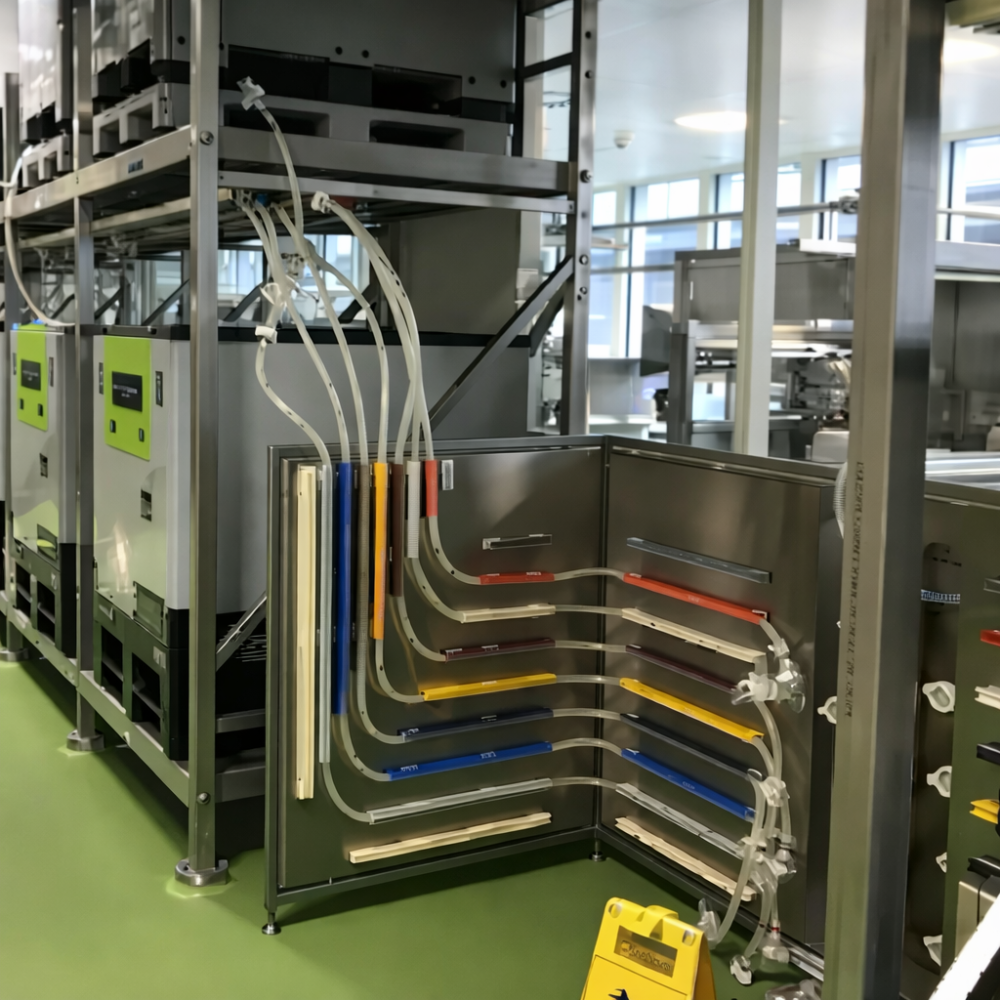
Assembly standardisation starts at the sourcing stage. Facilities that work with suppliers to develop a defined portfolio of validated assemblies — rather than ordering custom configurations product by product — reduce their qualification burden, simplify their operator training requirements, and build the institutional familiarity with assembly behaviour that supports reliable operations.
Supplier reliability and technical support capability are operational variables, not just procurement considerations. A supplier who can deliver consistent assemblies with stable documentation, proactive change notifications, and responsive technical support reduces the unplanned disruption risk that sits quietly inside every single-use manufacturing schedule.
For facilities across Southeast Asia and South Korea, the regional availability of technically capable single-use suppliers is a meaningful factor. Long international supply chains with extended lead times introduce planning constraints and supply risk that regional supply capability can mitigate. PharmNXT Biotech’s approach — engineering-led assembly design with supply reliability across 16+ countries, and growing adoption among biologics manufacturers in the region — reflects the kind of regional single-use ecosystem that reduces the supply chain fragility that otherwise offsets the operational advantages of disposable systems.
The Future of Agile Biologics Manufacturing in Asia
The trajectory for biologics manufacturing across South Korea and Southeast Asia points clearly toward more products, shorter campaigns, more facility sharing, and more aggressive production timelines. The CDMO model that has driven South Korea’s success is being replicated across the region — and it is a model that places a premium on exactly the operational characteristics that single-use systems support: fast turnaround, multi-product flexibility, and reliable contamination control.
The facilities being built today will define the region’s biologics manufacturing capacity for the next two decades. The operational decisions embedded in their design — about how extensively to deploy single-use technologies, how to structure their supply chains, how to standardise their assembly portfolios — will shape their competitiveness for years.
The direction is not difficult to read. Single-use systems will not replace all stainless-steel manufacturing in Asia or anywhere else. But for the fast, flexible, multi-product manufacturing that the region’s biologics pipeline demands, disposable systems are not an emerging technology. They are the present operational standard.
Closing Thought
Downtime is not just a scheduling problem. In biologics manufacturing, it is a patient supply problem, a revenue problem, and increasingly, a competitive problem.
Single-use systems do not eliminate operational complexity. But they shift it — away from the slow, fixed overhead of cleaning, validation, and maintenance, and toward the more manageable challenge of assembly discipline, supply chain planning, and standardisation.
For manufacturing teams building the next generation of biologics capacity across Asia, that shift is worth understanding deeply. The facilities that manage it well will be the ones that deliver consistently — and in this industry, consistency is everything.
#Bioprocessing #SingleUseSystems #BiologicsManufacturing #CDMOAsia #ManufacturingEfficiency #BioprocessEngineering #AsiaPharmaceuticals #PharmNXTBiotech #DowntimeReduction #SouthKoreaBiopharma #SEABiotech