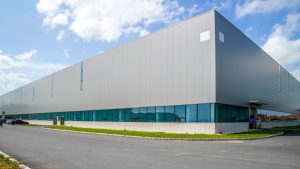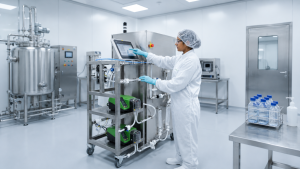


Asia is building biologics manufacturing capacity faster than almost any region in the world. The equipment underneath that capacity still travels a very long way to get there — and the industry has started treating that as a strategic problem, not a logistics footnote.
An Asymmetry Nobody Designed on Purpose
Every biologics facility commissioned across Asia this year will run on infrastructure that mostly wasn’t built in Asia. The bioreactor bags, sterile connectors, chromatography resins, and filtration capsules underneath the region’s manufacturing boom are still, overwhelmingly, imported.
This isn’t a controversial observation inside the industry — plant heads, procurement leads, and CDMO executives across India, South Korea, and Southeast Asia have lived with it for years. What’s changed is the willingness to name it as a strategic exposure rather than an operational fact of life, and to start doing something about it.
Built on Borrowed Infrastructure
The dependency has a rational history. Single-use bioprocessing technology matured in North America and Europe through the 2000s and 2010s, backed by decades of polymer science, gamma sterilization expertise, and validation infrastructure. When Asia’s biologics sector scaled rapidly from the mid-2010s onward, importing that mature technology was the fastest, lowest-risk route to GMP capacity. No facility was going to wait for a domestic film-extrusion ecosystem to mature before commissioning a bioreactor suite.
That was a reasonable sequencing decision at the time. It also meant the region’s manufacturing base grew several years ahead of its supply base — a gap that was manageable when volumes were modest and lead times were someone else’s problem. Neither condition holds today.
Two Warnings, Four Years Apart
COVID-19 is the reference point everyone reaches for, and it earned the position. Factory shutdowns and freight disruption in 2020 and 2021 turned single-use component lead times from a planning inconvenience into a genuine production constraint. Plenty of Asian facilities learned, the hard way, how little slack existed in their supply chains.
What gets discussed less is that the pattern didn’t end with the pandemic. As recently as April 2026, Indian API and solvent manufacturers were pushing for priority allocation of propylene, methanol, ammonia, and butane after regional feedstock inventories fell sharply amid disruption in West Asia — a reminder that chemical and biomanufacturing supply chains remain exposed to shocks that have nothing to do with biology at all.
COVID wasn’t a one-time stress test. It was the first of several, and it won’t be the last.
The Procurement Math Nobody Puts in the Deck
Custom single-use assemblies from established Western suppliers routinely carry lead times of sixteen to twenty-four weeks. For a facility running predictable, high-volume campaigns, that’s a scheduling parameter you design around. For a CDMO juggling multiple client programs with shifting timelines — increasingly the norm across South Korea and Southeast Asia’s fast-growing contract manufacturing sector — it’s a recurring constraint on how quickly the business can say yes to new work.
Layered on top of lead time is concentration risk, which has recently acquired a sharper edge. US biosecurity legislation targeting certain Chinese biomanufacturing suppliers has, over the past two years, been one factor redirecting global CDMO investment toward Korea, with Samsung Biologics’ continued campus expansion in Songdo among the clearest beneficiaries. Regardless of one’s view on the policy itself, the lesson for procurement and supply chain teams is unambiguous: a concentrated supplier base is a single point of failure that regulation or geopolitics can trigger just as easily as a factory fire or a shipping delay.
The Capacity Curve Asia Is Riding
None of this would matter as much if Asia’s biologics footprint were standing still. It isn’t. Samsung Biologics is developing a third Bio Campus in Incheon to support antibody-drug conjugates, vaccines, and cell and gene therapy production. Singapore now hosts more than sixty biopharmaceutical manufacturing plants across Tuas Biomedical Park and surrounding precincts, with recent expansions from Amgen, AbbVie, Novartis, and WuXi Biologics adding hundreds of millions of dollars in biologics drug-substance capacity. India’s CDMO and biosimilar sector continues extending its export footprint into Southeast Asia and beyond.
Each of these facilities represents a long-term commitment to single-use consumption at scale. The supply base underneath them needs to grow at a comparable pace — and right now, it’s playing catch-up.
Governments Have Started Underwriting the Fix
Policy has noticed. India’s Production Linked Incentive scheme for bulk drugs, key starting materials, and intermediates — an outlay of nearly ₹7,000 crore running through FY2028-29 — has already helped move the country from net importer to net exporter for select fermentation-based products, including Penicillin G and clavulanic acid, alongside a parallel ₹15,000 crore scheme supporting high-value biopharmaceuticals and complex generics. Three dedicated bulk drug parks are under development to lower the infrastructure barrier for new entrants.
South Korea’s National Bio Committee, established as a presidential advisory body in early 2025, now sits alongside a national bioresources master plan running through 2030 that explicitly prioritizes domestic bio-material and biomanufacturing capability. Singapore’s Economic Development Board continues backing manufacturing-innovation programs aimed at strengthening the country’s own production ecosystem, not just attracting more foreign investment.
None of these programs were designed around single-use consumables specifically. But each reflects the same recognition: upstream manufacturing dependency is now viewed as a strategic vulnerability worth public investment to correct.
Why “Cheaper Elsewhere” Stopped Being the Whole Argument
For years, the localization conversation in Asian bioprocessing got reduced to a cost comparison: could a regional supplier match an established Western manufacturer on unit price. That was always an incomplete way to frame the decision. An assembly that’s cheaper but arrives four weeks late, or can’t be re-supplied quickly after a change notification, doesn’t save money once you account for the cost of a delayed campaign or a missed delivery commitment.
What’s shifted is that procurement and manufacturing teams are increasingly pricing in that risk explicitly, rather than treating supply reliability as a footnote to a unit-cost comparison. That’s a more mature way to evaluate a supply chain — and it’s the single biggest reason localization has moved from a nice-to-have to a board-level conversation.
Localization’s Harder Half: Engineering, Not Assembly
The easy version of localization is building a facility that assembles imported film and imported components into a finished bag closer to the customer. That reduces freight time. It doesn’t reduce technological dependency, because the underlying engineering — material science, weld validation methodology, connector design — still originates elsewhere.
The harder, more durable version is building or acquiring the engineering capability itself. That can happen through sustained in-house R&D, or through acquiring proven technology outright — a route at least one Indian single-use manufacturer has taken directly, acquiring an Ireland-based tubing-routing specialist to bring its design methodology into Indian manufacturing rather than simply distributing the imported product. Either path takes longer than setting up an assembly line. It’s also the only version of localization that actually closes the dependency gap, rather than relocating it by a few thousand kilometres.
Proximity and Standardization: The Trust That Follows
Assuming the engineering capability is real, proximity still delivers something a longer supply chain structurally can’t: technical support that arrives in hours rather than weeks, in the same time zone, with direct familiarity with the regulatory environment a facility operates in. When an integrity test fails or a weld batch needs investigating, that responsiveness often separates a contained deviation from an extended production stoppage.
None of it matters, though, if regional manufacturing doesn’t hold to the same standard as the suppliers it’s meant to replace. Validated assemblies, documented change control, batch traceability to irradiation records, and quality systems aligned to ISO 13485 aren’t negotiable simply because a supplier is regional. Localization that trades reliability for proximity solves the wrong problem. The suppliers earning trust across the region right now are the ones matching international documentation and validation standards — not the ones offering a discount for being local.
Who Builds the Next Decade
The companies best positioned to lead this shift are the ones treating localization as an engineering problem first and a manufacturing-footprint problem second. That combination — regional presence paired with genuine technical depth — is still relatively rare, which is exactly why it’s becoming a differentiator worth watching.
PharmNXT Biotech’s trajectory is a useful illustration of the pattern, not because it’s unique, but because it’s representative of where the region’s supply base needs to go. Built around a “Make in India for the World” philosophy, the company manufactures its single-use consumables and equipment in-house at its Ekuse facility rather than distributing imported product, has extended its supply reach across 14-plus countries including key Southeast Asian and Korean markets, and has pursued engineering capability directly — its acquisition of an Irish tubing-routing specialist is a clearer signal of intent than any marketing claim could be. Companies following this pattern, wherever they’re based, are the ones that will define what a genuinely resilient regional supply base looks like a decade from now.
A Multi-Decade Transition, Not a Single Milestone
Asia will not stop importing single-use technology, and it shouldn’t try to. A global industry benefits from global technology exchange, and no region needs to manufacture everything it consumes. What’s changing is the balance — from a supply base that’s almost entirely imported to one where regional engineering, regional manufacturing, and regional support carry a fair share of the load.
That shift will take a decade, not a product cycle. But the direction is no longer in question. The facilities being commissioned today are placing that bet already. The only open question is which suppliers will have built the capability to meet them there.
#Bioprocessing #SingleUseSystems #BiopharmaAsia #SupplyChainResilience #Localization #CDMO #MakeInIndia #BiologicsManufacturing #SouthKoreaBiopharma #PharmNXTBiotech